Strong Acids and Bases:
(If it is an acid or a base and it is not in this table, then it is a weak acid or base. An indicator that something is an acid is that it will start with a hydrogen, ex: H3PO3, H3PO4).
Three Definitions:
1. Arrhenius Concept of Acids and Bases:
-Acid: a substance that, when dissolved in water, increases the concentration of hydronium ion, H3O+ (aq). H+ (aq) is interchangeable with H3O+ (aq), but remember that it is not just a lone proton, but a proton chemically bonded to water (and with other water molecules via hydrogen bonding).
-Strong Acid: a substance that completely ionizes in aqueous solution to give H3O+ (aq) and an anion.
Example:
HCl (aq) + H2O (l) → H3O+ (aq) + Cl- (aq)
Hydrochloric acid donates a hydrogen to the water molecule to yield a hydronium ion. Hydrochloric acid thus increases the hydronium ion concentration of the solution and is considered an Arrhenius acid.
-Base: a substance that, when dissolved in water, increases the concentration of hydroxide ion, OH- (aq).
-Strong Base: a substance that completely ionizes in aqueous solution to give OH- and a cation.
-Weak Acids and Bases: are not completely ionized in solution and exist in reversible reaction with the corresponding ions.
Example:
NaOH (aq) → Na+ (aq) + OH- (aq)
Sodium hydroxide dissociates in water and increases the concentration of hydroxide ion. It is thus considered an Arrhenius base.
2. BrØnsted-Lowery Concept of Acids and Bases:
Independently, these two guys came up with a more flexible definition of acids and bases.
Acid: the species donating a proton in a proton-transfer reaction.
Base: the species accepting the proton in a proton-transfer reaction.
Example:
HCl (aq) + H2O (l) → H3O+ (aq) + Cl- (aq)
Hydrochloric acid donates a proton to water to yield H3O+, and water accepts a proton to become H3O+. So here, Hydrochloric acid is the acid and water is the base.
Example:
NH3 (aq) + H2O (l) → NH4+ (aq) + OH- (aq)
Ammonia accepts a proton from water to yield an ammonium ion and a hydroxide ion. So here, water is the acid, and ammonia is the base.
Conjugate Acid-Base Pair: consists of two species in an acid-base reaction, one acid and one base, that differ by the loss or gain of a proton. The acid of the pair is called the conjugate acid of the base, and the base is called the conjugate base of the acid. (ex: NH3 and NH4+, remember when you add the hydrogen to add one positive charge)

-Amphiprotic/Amphoteric Species: a species that can act as either an acid or a base (it can gain or lose a proton) depending on the other reaction. (ex: OH– ← H2O → H3O+).
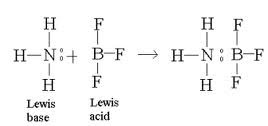
3. Lewis Concept of Acids and Bases:
Lewis Acid: a species that can form a covalent bond by accepting an electron pair from another species.
Lewis Base: a species that can form a covalent bond by donating an electron pair to another species.
Example:


Relative Strengths of Acids and Bases:

As seen in the above table, the strongest acids have the weakest conjugate bases, and the strongest bases have the weakest conjugate acids. This table can be used to predict the direction of an acid-base reaction: the normal direction of reaction is from the stronger acid and base to the weaker acid and base.
Molecular Structure and Acid Strength:
-The strength of an acid depends on how easily the proton, H+, is lost or removed from an H-X bond in the acid species. (ex: H-X = H-Cl, H-X = H-Br, etc.)
1) In going down a column of elements of the periodic table, the size of atom X increases (have more and more electrons), the H-X bond strength decreases, thus increases the strength of the acid.
Example: Group VIIA elements: HF, HCl, HBr, HI = HI > HBr > HCl > HF
2) Going across a row of elements of the periodic table, the electronegativity increases, the H-X bond polarity increases, and the acid strength increases.
3) An oxoacid has the structure H-O-Y- where the acidic H atom is always attached to an O atom, which, in turn, is attached to an atom Y. Other groups may be attached to Y.
-For a series of oxoacids of the same structure, differing only in the atom Y, the acid strength increases with the electronegativity of Y.
Example: HClO, HBrO, and HIO. Consider the electronegativities of Cl, Br, and I.
HClO > HBrO > HIO
4) For a series of oxoacids with the structure H-O-Y-On, with the same Y, more O's = higher acid strength.

5) The acid strength of a polyprotic acid and its anions decreases with increasing negative charge.
Example: H3PO4 > H2PO4- > HPO42- (the negative charge acts on the proton to hold it in tighter and make it less acidic).
Self Ionization of Water:
Self-Ionization/Autoionization: a reaction in which two like molecules react to give ions.
H2O (l) + H2O (l) ⇌ H3O+ (aq) + OH– (aq)
Ion-Product Constant for Water: (a different version of Kc)
Kw = [H3O+][OH-] = 1.00 x 10⁻¹⁴ (at 25 degrees Celsius)
-Just like Kc, no units of measure
-Can be rearranged to find hydronium and hydroxide ion concentrations
[H3O+] = 1.00 x 10⁻¹⁴ / [OH-]
[OH-] = 1.00 x 10⁻¹⁴ / [H3O+]
Example:
What is the [OH-] for 0.150 M HCl in the following reaction?
HCl (aq) + H2O (l) → H3O+ (aq) + Cl- (aq)

We know the concentration of water is constant because it is a pure liquid, and we know that HCl dissociates completely (to 0M) because it is a strong acid.
So now we know the [H3O+] is 0.150 M, so:
[OH-] = 1.00 x 10⁻¹⁴ / 0.150M = 6.67 x 10⁻¹⁴ M
-In a neutral solution, [H3O+] = [OH-]
-In an acidic solution [H3O+] > [OH-]
-In a basic solution [H3O+] < [OH-]
The pH of a Solution:
-Defined as the negative logarithm of the molar hydronium ion concentration. (pH = percent hydrogen).
pH = -log [H3O+]
or
[H3O+] = 10-pH
(Note: it is possible for pH to be larger than 14 and less than 0, it's just very uncommon)
-The lower the pH, the more acidic; the higher the pH, the more basic. Can also be used with [OH-].
pOH = -log [OH-]
or
[OH-] = 10-pOH
Also:
pH + pOH = 14